Introducing LACE: breaking the duplex barrier
Lane-granularity optical circuit scheduling for large language model training.
Our new preprint, Breaking the Duplex Barrier: Lane-Granularity OCS Scheduling for LLM Training, explores a simple question: if optical paths are directional, why must we always schedule them in symmetric pairs?
We introduce LACE (Lane-level Circuit Scheduling), an offline compiler that turns a training communication schedule into physical optical connections. It allocates transmit (TX) and receive (RX) lanes independently, while preserving the selected collective algorithms, operation order, and rank placement.
Read the paper on arXiv · Download the PDF
The opportunity: traffic has a direction
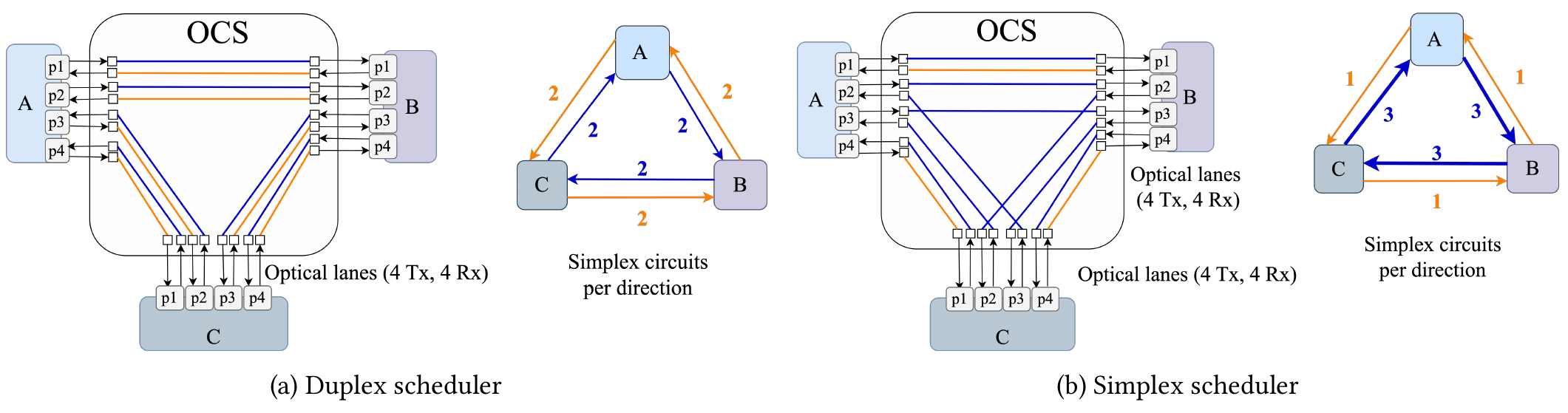
Optical circuit switches (OCSes) let a network change its physical connectivity to suit a workload. Conventional demand-aware schedulers allocate duplex port pairs: adding capacity from A to B also adds the same capacity from B to A.
LLM training does not always need that symmetry. A data-parallel ring may send data to one neighbor and receive from another. Pipeline stages send activations forward and gradients backward in different windows. Even when a server sends and receives equal total volumes, individual node pairs can have very different demands in opposite directions.
The result is a mismatch: capacity can sit idle in one direction while the other direction remains a bottleneck. LACE treats each port’s TX and RX lanes as separate resources, allowing them to connect to different peers. Here, a lane means one direction of a port’s optical fiber pair, rather than a SerDes or wavelength lane inside a transceiver.
From a training schedule to optical connections
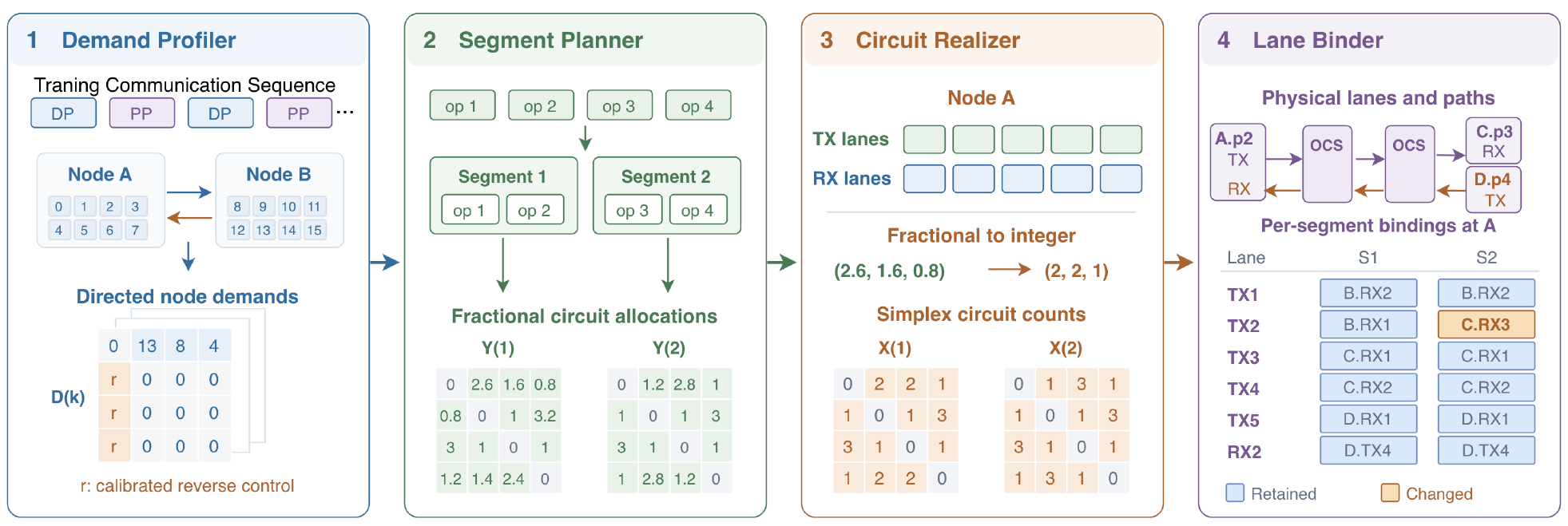
Directionality is only part of the problem. Every connection consumes a source TX lane and a destination RX lane, and every topology change costs time. LACE therefore decides both how to allocate lanes and when consecutive operations should share a configuration.
Its compiler has four stages:
- Demand Profiler. Expand communication operations into directed transfers, map ranks to server or switch nodes, and aggregate bytes by ordered node pair. Include calibrated control traffic so feedback also has capacity.
- Segment Planner. Group consecutive operations and estimate fractional lane allocations. Keep a shared configuration when avoiding reconfiguration saves more time than a better traffic match would recover.
- Circuit Realizer. Convert fractional targets into integer simplex-circuit counts while respecting each node’s TX/RX inventory and preserving demanded directions. Check the resulting communication time against the planning tolerance.
- Lane Binder. Assign physical lanes and optical paths. Reuse existing connections where possible, account for multi-OCS path constraints, and repair allocations or request replanning when necessary.
Execution also needs endpoint support. The paper prototypes software acknowledgments over independently provisioned return paths, and coordinated link configuration and recovery that verify a configuration before communication resumes. These mechanisms accompany scheduling; optical flexibility alone does not guarantee that a particular NIC, module, and firmware combination will support different TX/RX peers.
What we measured
Three-server hardware testbed
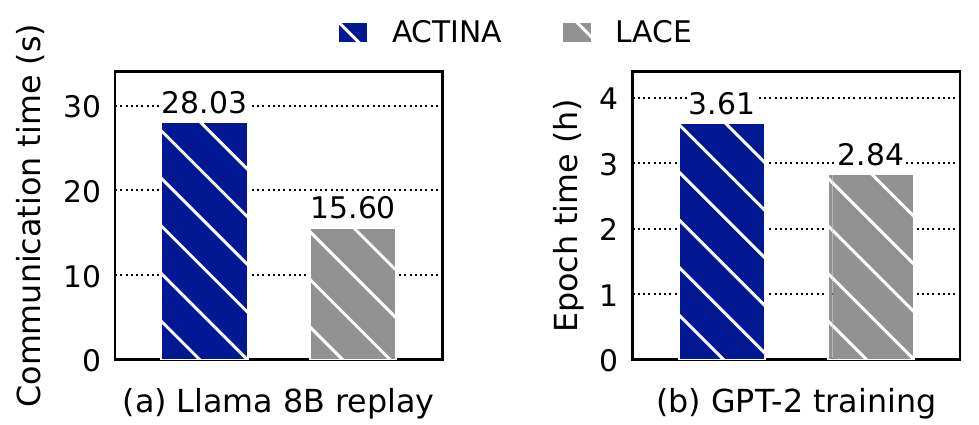
We connect three GPU servers to an 8 × 8 Polatis OCS, with two 100-Gb/s ports per server. LACE and the symmetric ACTINA baseline each use a fixed topology throughout the replay or training run, with matched per-port rate limits and the same TCP striping policy.
- Communication replay: 28.03 → 15.60 seconds, a 1.80× speedup, for the mixed DP/PP schedule of a LLaMA-3.1 8B workload.
- GPT-2 training: 3.61 → 2.84 hours, a 1.27× speedup, for one GPT-2 Small fine-tuning epoch on WikiText-103.
The replay measurement is the median of two runs; the training result is one epoch per topology. These experiments demonstrate the value of asymmetric connectivity on this setup. They do not constitute a dynamically reconfigured, multi-NIC software-ACK training deployment: software-ACK performance and configuration recovery are evaluated separately.
Larger-scale scheduling simulations
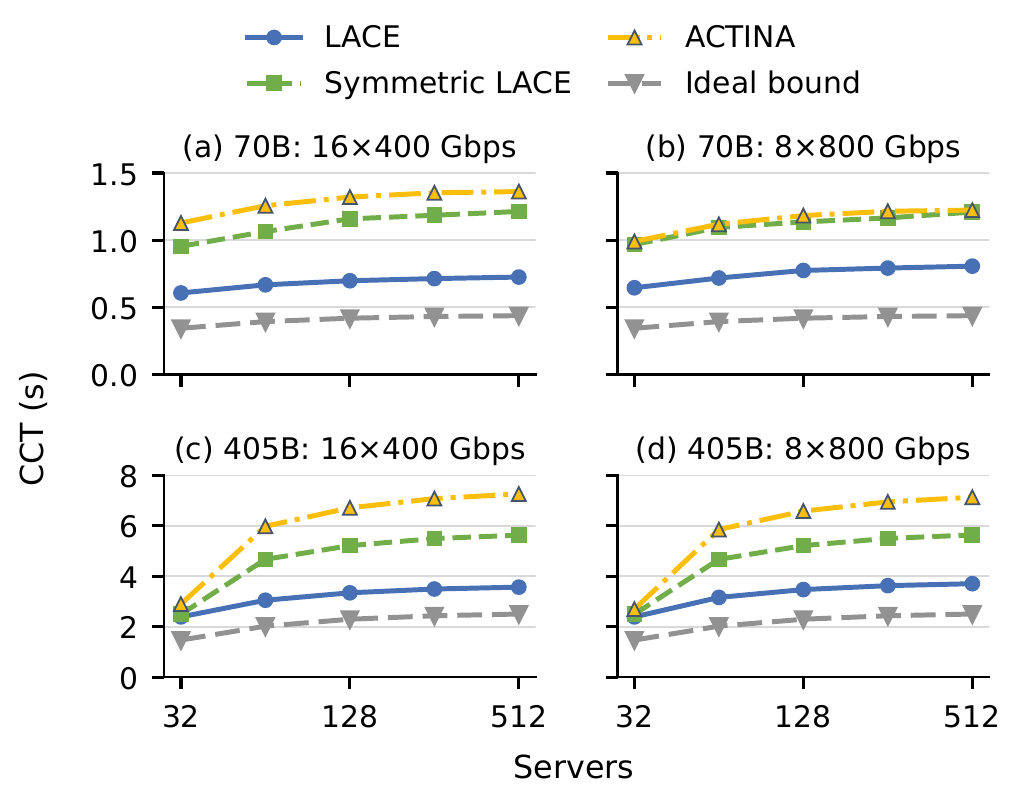
For LLaMA-3.1 70B and 405B schedules on 32–512 eight-GPU servers, the main simulated configuration gives each server sixteen 400-Gb/s ports: 6.4 Tb/s in each direction. With a default modeled reconfiguration delay of 20 ms, LACE delivers 1.21–2.04× communication speedup over ACTINA across these workloads.
These are communication completion time (CCT) results. The model excludes computation, compute/communication overlap, packet dynamics, and host-side transport processing limits. The measured hardware prototype has second-scale recovery; the millisecond-delay simulations assume faster recovery. The simulated gains should therefore be read as scheduling results, rather than end-to-end training speedups on today’s prototype.
Where this leads
LACE shows why the direction of communication should be part of optical resource scheduling. The opportunity depends on the workload, rank placement, port inventory, and the demand that remains after aggregation. Practical deployment also depends on endpoint compatibility, return-path support, and recovery cost.
The current compiler plans an ordered schedule offline. Extending it to overlapping operations, dynamic expert routing, and a complete multi-NIC runtime are directions for further work.
Paper and citation
Breaking the Duplex Barrier: Lane-Granularity OCS Scheduling for LLM Training
Bangbo Liang, Yupeng Chen, Sicheng Zhao, Peihao Huang, Di Yang, Bohua Xu, Bin Yang, Shizhen Zhao, and Guo Chen.
arXiv preprint, first submitted September 13, 2026.
arXiv abstract · Full paper (PDF) · HTML version
All four figures are reproduced from our paper, arXiv:2609.14253v1. The source figure numbers are retained in their captions.