Hi, I'mBangbo Liang. 梁帮博
Exploring the systemsconnect us.
I study high-performance networks and computer architecture, with a focus on optical interconnects for distributed AI training. Here, I share my research, things I build, and moments along the way.
NEW RESEARCH Meet LACE: lane-level optical scheduling ↗
RESEARCHER & CURIOUS HUMAN Based in Changsha, China ↗ Always curious.
CURRENTLY THINKING ABOUT Optical networks ✳ High-performance systems ✳ Hardware–software co-design
01 / RESEARCH & PROJECTS
Making connections.Building understanding. From optical switching to collective communication, I'm interested in how we make data center networks work better.
LATEST RESEARCH ARXIV PREPRINT · 2026
Optical paths are directional. Our new work schedules transmit and receive lanes independently to match the communication demands of LLM training.
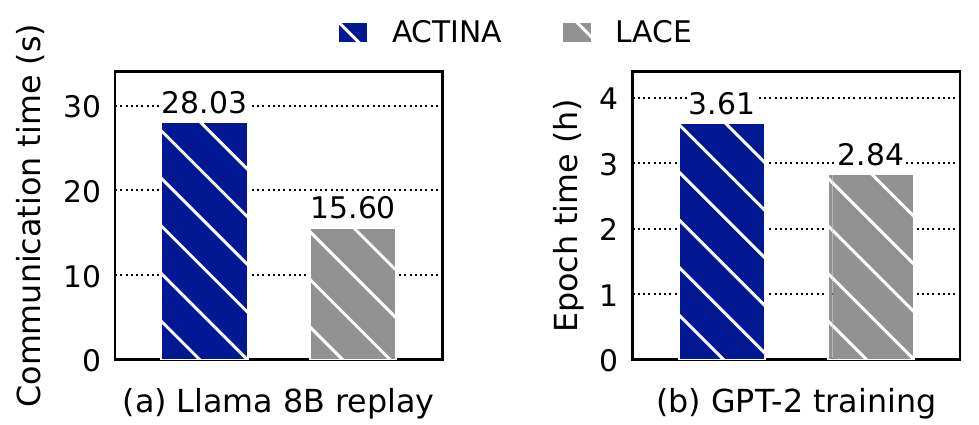
Fixed-topology testbed · Original paper, Figure 5
1.21–2.04× Simulated communication speedup
1.80× Communication replay speedup
1.27× GPT-2 training speedup
Compared with ACTINA. Simulation and hardware experiments are separate evaluations.
PUBLICATION 2025
Rethinking networks for Full-Stack Technology White Paper on Optical-Electrical Hybrid Switching Networks for Intelligent Computing Centers.
Read the white paper ↗ OPEN SOURCE 2024
RDMA-perftest $ ./MyPerfv8 -t 100→ Precise intervals.→ A clearer view of performance._
Small intervals. A lightweight RDMA performance testing tool with microsecond-level test cycles and configurable operations.
Explore RDMA-perftest ↗
01 High-performance networks Data center interconnects and efficient communication.
02 Optical networking Protocol stacks and collective communication optimization.
03 Computer architecture Exploring the boundary between hardware and software.
Research notes, code, and the occasional detour into life.
Nov 01, 2026
Research ↗
Aug 20, 2025
Research ↗
Nov 19, 2024
Technical ↗
Oct 30, 2024
Technical ↗